By Andrew Tan
The word nobody defined
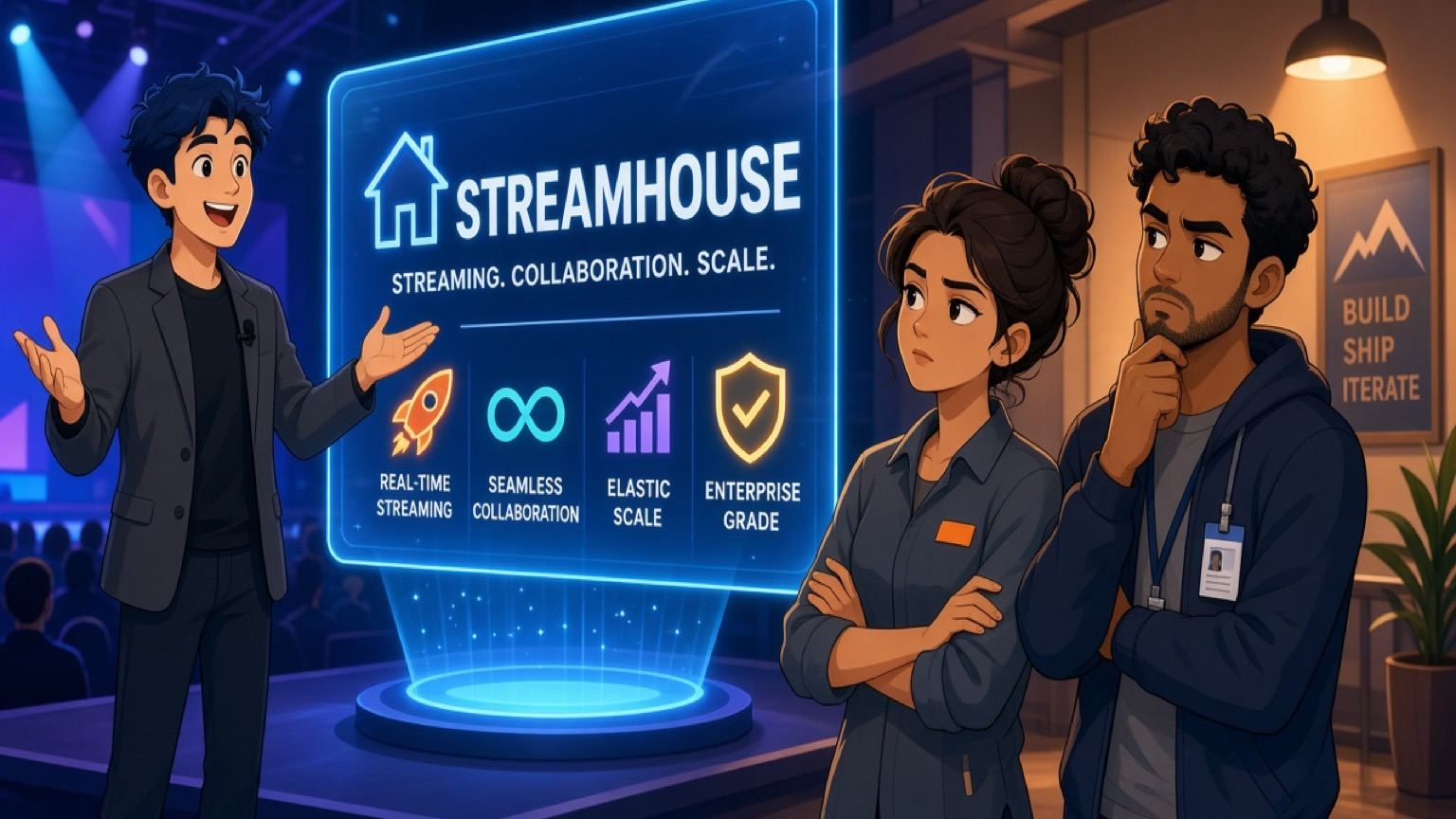
I was on a panel last month when someone used the word "streamhouse" five times in two minutes. They were earnest about it. They said it was "the biggest shift in data architecture since the lakehouse." They said it would "collapse the boundary between streaming and analytics." They said teams that didn't adopt it would be "maintaining legacy batch infrastructure" within eighteen months.
After the panel, I asked them what a streamhouse actually is.
They paused. Then they said: "It's when your streaming platform and your warehouse become the same thing." I asked for an example. They said Kafka with Iceberg. I asked how that's different from what Flink already does. They said the streamhouse is "native." I asked what "native" means in this context. They said it means you don't need a separate job to move data from the stream into the warehouse. I asked what happens when the stream needs to be replayed, or backfilled, or joined to a slowly changing dimension table. They said those are "implementation details."
They were a vendor. They were selling something. But the word itself is now in the wild, and I've heard it from data architects, platform leads, and even a CTO who told me their 2027 strategy is to "streamhouse the analytics stack."
So let's do what the marketing doesn't: define the thing, separate the real change from the repackaging, and figure out whether this is a category you should care about or just a new label for complexity you already have.
What "streamhouse" is supposed to mean
The term comes from a working group announced earlier this year by Confluent, Aiven, Redpanda, StreamNative, and Ververica. The pitch is straightforward: streaming data and analytical data have lived in separate systems for too long. Kafka handles the stream. Snowflake handles the analytics. You build a pipeline between them. The pipeline breaks. Everyone blames the other team.
The streamhouse proposal is to unify them. Streaming data lands in open table formats — Iceberg, Delta Lake, Paimon — as it arrives. Query engines read those tables directly. No ETL job. No batch sync. No "landing zone" that gets stale between runs. The stream is the table. The table is the stream.
Confluent calls this Tableflow. Aiven calls it Aiven Streams. The exact branding changes by vendor, but the architecture is consistent:
- Events arrive in a streaming layer (Kafka, Redpanda, Pulsar).
- A streaming engine (Flink, Spark Structured Streaming, or a vendor-specific runtime) writes them incrementally into an open table format.
- Query engines (Trino, DuckDB, Snowflake, BigQuery) read the table as if it were a normal warehouse table.
- The table is "continuously updated" rather than "periodically refreshed."
This is not a scam. There is a real technical achievement here. Making a streaming pipeline produce queryable table files in near-real-time, with schema evolution, compaction, and snapshot isolation, is genuinely hard. The teams building this deserve credit.
But the architecture is not new. It's a refinement of something Flink, Kinesis Analytics, and even some bespoke Kafka-to-S3 pipelines have been doing for years. What's new is the marketing umbrella: the word "streamhouse," the working group, the promise that this pattern removes the need for separate batch and streaming systems.
That last part is the stretch.
What changes — and what doesn't
Let's separate the real from the aspirational.
What actually gets better:
- Latency to queryable data drops. If you're running a batch sync every hour, moving to continuous micro-batching or true streaming cuts that to seconds or minutes. For use cases where freshness matters — fraud detection, operational dashboards, real-time pricing — this is a genuine improvement.
- Schema evolution is cleaner. Open table formats handle schema changes better than most bespoke streaming-to-warehouse pipelines. Adding a column doesn't require a migration script. Renaming a field is tracked in metadata. This reduces the "who broke the dashboard" incidents.
- One storage layer, fewer copies. If your analytics team can query the same Iceberg files that your streaming pipeline produces, you don't need a separate warehouse extract. Fewer copies means fewer sync jobs, fewer consistency windows, and fewer places for data to diverge.
What stays exactly the same:
- Orchestration. A streamhouse does not remove the need to coordinate jobs, dependencies, and retries. If your streaming pipeline feeds a dbt model that feeds a dashboard, that DAG still needs to be managed. The streamhouse replaces the batch extraction step. It does not replace the orchestration layer.
- Backfills and replays. When a bug corrupts three days of streamed data, you need to rewind the log and reprocess. The streamhouse table format makes this possible. It does not make it easy. You still need to manage consumer offsets, handle schema changes that happened mid-stream, and verify that replayed data matches what downstream systems already saw.
- Cross-system workflows. Most real pipelines touch more than one system. A stream might trigger an API call, update a cache, write to a database, and produce a notification. The streamhouse handles the analytics path. It does not handle the operational path. You still need a runtime that can coordinate across systems with different consistency models and failure modes.
- Cost structure. Streaming infrastructure is always-on infrastructure. A batch job that runs for ten minutes every hour costs ten minutes of compute per hour. A streaming job that runs continuously costs sixty. The streamhouse shifts cost from sync jobs to streaming compute. Whether that's cheaper depends on your volume, your query patterns, and how well you tune compaction.
The streamhouse improves the storage and queryability of streaming data. It does not remove the need for a runtime that handles the messy operational work around that data.
The continuous table illusion
The most seductive idea in the streamhouse pitch is the "continuous table." It's a table that never goes stale. You query it and you get the latest data. No batch job. No waiting. The table is alive.
This is a powerful mental model. It's also slightly misleading.
A continuous table is not a single object that updates in place. It's a sequence of snapshots, each representing the table at a point in time. When you query it, you're reading one of those snapshots. The query engine chooses the latest one it knows about. The streaming engine is constantly appending new files and committing new snapshots.
This matters because the gap between "the latest event arrived" and "the latest snapshot is queryable" is not zero. It depends on:
- Commit frequency. How often does the streaming engine write a new snapshot? Every second? Every minute? The faster, the more metadata overhead.
- Compaction lag. The table accumulates small files. Queries slow down. Somebody — or some scheduled job — has to compact those files into larger ones. During compaction, query behavior can change.
- Catalog consistency. The query engine learns about new snapshots through a catalog. If the catalog is eventually consistent — and most are — a query might read a snapshot that's thirty seconds behind the actual stream. Thirty seconds is not real-time. It's near-real-time wearing a real-time costume.
The continuous table is a useful abstraction. But it's still an abstraction over a batch-of-micro-batches process. The files are discrete. The snapshots are discrete. The freshness is bounded by commit intervals, compaction schedules, and catalog latency. Calling it "continuous" obscures the engineering reality, which is: smaller batches, faster commits, same coordination problems.

Where teams still end up stitching runtimes together
Here's the scenario the streamhouse marketing doesn't show you:
You have a streaming pipeline that writes events into an Iceberg table. Your analytics team queries it with Trino. Your ML team reads it with Spark. Your operational team needs to trigger an alert when a specific event pattern occurs — not after the event lands in the table, but when it arrives in the stream.
The streamhouse handles the analytics and ML paths. But the operational alert needs to run against the stream itself, before the event is committed to a table snapshot. So you stand up a separate Flink job to process the raw stream. Now you have two runtimes: one for the table path, one for the operational path.
Then the business asks for a weekly report that reconciles the streamed data with the batch data from your ERP system. The ERP data doesn't arrive in a stream. It arrives as a daily CSV dump. So you build a batch job that reads the CSV, joins it to the Iceberg table, and produces the report. Now you have three runtimes.
Then someone discovers that the streaming pipeline produced bad data for six hours last Tuesday because of a schema drift. You need to rewind the stream, fix the logic, and replay. But the replay has to produce exactly the same table snapshots that downstream queries already saw, or the ML team's training run will be inconsistent. So you coordinate the replay with the ML team's pipeline. Now you're doing runtime orchestration across four systems.
The streamhouse solved the "how do I query my stream" problem. It did not solve the "how do I coordinate multiple runtimes with different semantics" problem. That problem is still yours.
The honest decision framework
If you're evaluating whether the streamhouse pattern makes sense for your team, don't start with the architecture diagram. Start with what you're actually trying to do.
Use a streamhouse when:
- Your primary use case is analytics or ML on data that arrives continuously, and your current batch sync is the bottleneck.
- You already run Kafka (or Redpanda, or Pulsar) and you're tired of maintaining separate pipelines to move that data into a warehouse.
- Your query patterns are compatible with open table formats — columnar reads, predicate pushdown, snapshot isolation — and you're not trying to do sub-second operational triggers.
- You have the team to manage compaction, catalog consistency, and schema evolution at streaming velocity.
Don't use a streamhouse when:
- Your "streaming" use case is actually a batch job that runs every fifteen minutes. The streamhouse is not free. If nobody needs data faster than fifteen minutes, you're paying continuous compute for intermittent value.
- You need operational triggers — API calls, cache updates, notifications — that must fire on event arrival, not on table commit. The streamhouse is an analytics pattern, not an operational pattern.
- Your team is already struggling with open table format operations. The streamhouse adds streaming velocity to those operations. If compaction and catalog management are already painful, making them faster doesn't make them easier.
- You're hoping it will replace your orchestration layer. It won't. You'll still need something to manage dependencies, retries, backfills, and cross-system workflows.
The streamhouse is a storage and query pattern. It is not a runtime pattern. If your problems are storage and query problems — stale data, sync lag, too many copies — it's worth evaluating. If your problems are runtime problems — coordination, failure recovery, cross-system semantics — the streamhouse doesn't help and may add complexity.
What the vendors are really selling
I don't think the streamhouse working group is being dishonest. I think they're being selective. They're showing the use cases where the pattern shines — real-time analytics, continuous ML feature stores, operational dashboards — and quietly omitting the use cases where it doesn't.
What they're really selling is a shift in center of gravity. For the last decade, the warehouse was the center of the data universe. Everything flowed into it. The streamhouse proposal says the stream is the center, and the warehouse is just one consumer of many.
This is a meaningful shift for some organizations. If your business is event-driven — fraud detection, IoT, real-time trading — the stream-first model makes sense. But most organizations are not event-driven. They're schedule-driven. They run reports. They update dashboards. They retrain models overnight. For these teams, moving the center of gravity to the stream is a solution in search of a problem.
The vendors know this. That's why the marketing emphasizes "future-proofing" and "modern data architecture" rather than specific operational improvements. The streamhouse is positioned as an inevitable evolution, like the cloud or the lakehouse before it. The subtext is: if you're not doing this, you're falling behind.
Maybe. But "falling behind" what? If your batch pipelines are reliable, your stakeholders are happy, and your costs are predictable, adopting a streamhouse because a vendor says it's inevitable is not modernization. It's architecture by FOMO.
Where we fit in
At layline.io, we don't sell a streamhouse. We sell a runtime that handles both batch and streaming in the same pipeline, on the infrastructure you already have.
The reason this matters: a lot of teams are evaluating the streamhouse because they want batch and streaming to coexist without maintaining two separate stacks. That's a real problem. But the streamhouse solves it by unifying storage around the stream. We solve it by unifying runtime around the workflow.
If your analytics team needs a warehouse table and your operations team needs a stream trigger, both paths can run through the same pipeline logic, the same observability, and the same failure recovery. The storage format becomes a configuration choice — Iceberg when it helps, Parquet when it doesn't, a message bus when you need operational latency — rather than an architectural commitment.
The streamhouse is a useful pattern for a specific set of problems. It's not a universal architecture, and it's not a replacement for the operational runtime that keeps your pipelines working at 2 AM. The teams that succeed with it are the ones who adopt it for the right reasons — query latency, reduced sync overhead, cleaner schema evolution — and don't expect it to solve problems it was never designed to touch.
The buzzword will fade. The underlying technology — continuous ingestion into open table formats — will stick around and improve. The question is whether your team needed it before the marketing told you that you did.
If your team is trying to separate the streamhouse signal from the noise — or if you're looking for a runtime that handles batch and streaming without forcing you to pick a storage religion — get in touch. We've helped teams evaluate this exact tradeoff, and the answer is usually simpler than the architecture diagrams suggest.

Andrew Tan is a serial entrepreneur and founder of layline.io, building enterprise data processing infrastructure that handles both batch and real-time workloads at scale.