Modern ETL/ELT Without the Complexity
Build production-ready data pipelines in hours with visual format configuration, real-time streaming, and zero-dependency deployment.
Unlike traditional ETL tools that require separate systems for extraction, transformation, and loading, layline.io provides a unified pipeline with native format parsing and real-time intelligence.
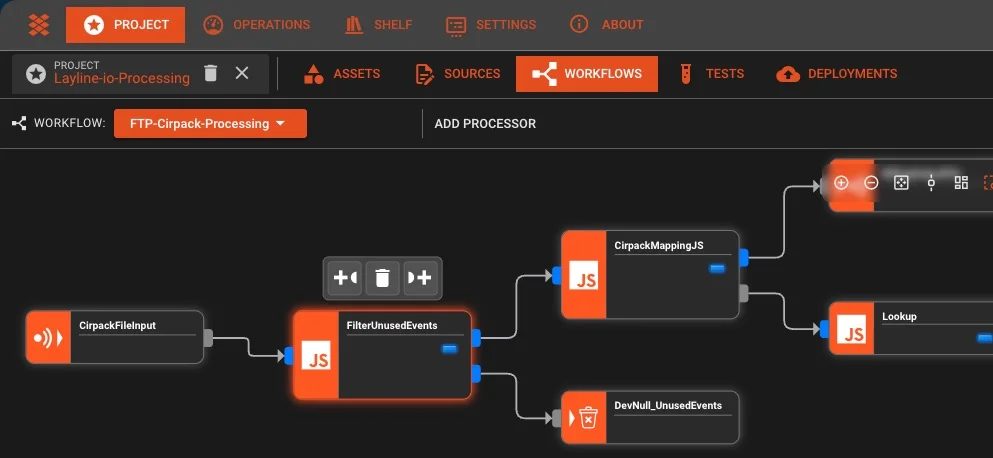
Real-World ETL/ELT Scenarios
From financial transactions to IoT sensor streams, see how unified pipelines solve complex data integration challenges
Financial Services
1M+ transactions/day · <50ms latency
Traditional ETL
- Opaque blob processing—no understanding of transaction fields
- Custom parsers for each format (SWIFT, ISO 20022, XML)
- Manual routing rules—breaks when schemas change
- Batch delays—hours to process high-value transactions
TOOLS REQUIRED
With layline.io
- Configure SWIFT and XML-based formats visually—instant field access
- Content-aware routing based on amount, country, risk score
- Automatic schema adaptation—zero downtime updates
- Real-time streaming—<50ms end-to-end latency
UNIFIED PLATFORM
DATA FLOW
E-Commerce
100K+ SKUs · Real-time sync
Traditional ETL
- Dozens of custom connectors for each supplier format
- Can't mix real-time APIs with batch file drops
- Manual schema mapping breaks with supplier changes
- Stale product data—hours or days behind
TOOLS REQUIRED
With layline.io
- Built-in CSV, XML, JSON—configure formats visually
- Unified pipeline for real-time APIs + batch files
- JavaScript/Python for custom transformation logic
- Incremental updates—only changed products synced
UNIFIED PLATFORM
DATA FLOW
Telecoms
Billions of CDRs · Carrier-grade
Traditional ETL
- Batch windows can't meet SLA requirements
- Dropped records during traffic spikes = revenue loss
- Custom parsers for telecom-specific formats
- Complex multi-system architecture for routing
TOOLS REQUIRED
With layline.io
- Reactive streaming—sub-millisecond processing
- Backpressure handling—zero data loss at peak loads
- Configure any format ASCII/Binary/ASN.1, etc.
- Content-aware routing to billing, fraud, analytics
UNIFIED PLATFORM
DATA FLOW
IoT & Manufacturing
100K+ events/sec · Edge/Cloud
Traditional ETL
- Batch processing can't keep up with 100K+ events/sec
- Network issues = data loss without buffering
- Separate solutions for edge vs cloud deployment
TOOLS REQUIRED
With layline.io
- Reactive streaming handles millions of events/sec
- Backpressure buffering—zero data loss guaranteed
- Same pipeline deploys to edge or cloud—your choice
UNIFIED PLATFORM
DATA FLOW

One Data Dictionary. Any Format Unified.
layline.io generates a common data dictionary from all configured formats in your project. No manual mapping. No custom parsers. Just configure your formats and work with unified, typed data across your entire pipeline.
How the Unified Data Dictionary Works
1. Define your data format within layline.io's visual editor. Ask for ready-made templates.
2. layline.io analyzes all configured formats and creates a unified data dictionary with typed fields, relationships, and validation rules.
3. Access fields like message.data.amount or message.data.transaction.currency regardless of source format. Database queries? Define your own dictionary amendments to match DB schemas.
No manual field mapping between formats. No custom parsing code. The dictionary is your single source of truth.
Structured Data
Financial & Banking
Healthcare
Telecommunications
IoT & Industrial
Databases & Cloud Platforms
Don't see your format? layline.io's extensible architecture allows you to add custom format parsers via JavaScript or Python.
Ask About Custom FormatsHow layline.io Compares
A clear view of what sets modern, content-aware ETL/ELT apart
How layline.io Compares to Traditional ETL/ELT Tools
| Feature | layline.io | Traditional ETL (Talend, Informatica) | Modern Orchestrators (Dagster, Airflow) |
|---|---|---|---|
| Real-time Streaming | Add-on | ||
| Batch Processing | |||
| Native Format Parsing | Unlimited | 10-20 formats | Custom code |
| Visual Workflow Editor | Limited | ||
| Code/Scripting | JavaScript/Python | Java | |
| Local Development | Server required | Complex setup | |
| Deployment Time | Minutes | Days-Weeks | Days |
| Infrastructure Dependencies | Zero | Heavy | DB, Queue,<br>Workers |
| Typical Latency | Milliseconds | Minutes-Hours | Minutes |
| Learning Curve | Gentle | Medium | Steep |
| Total Cost of Ownership | $ | $$$$ | $$ (infra) |
Everything You Need to Know AboutETL/ELT Pipelines
Common questions about modern data integration with layline.io
Traditional ETL tools are designed primarily for batch processing and require heavy infrastructure. layline.io combines real-time streaming and batch processing in a single platform with zero infrastructure dependencies. While tools like Talend excel at visual design, they often struggle with real-time data and require complex server setups. layline.io runs on your laptop for development and deploys in minutes to production, handling both real-time streams and batch jobs with the same workflow.
layline.io provides powerful format engines for structured ASCII (CSV, fixed-width, delimited), XML, ASN.1-based formats, and custom binary structures—all configurable through the visual editor without coding. From these building blocks, you can define virtually any standard or proprietary format: financial messages like SWIFT, healthcare formats, EDI variants, telecom CDRs, and more. All configured formats automatically contribute to a unified data dictionary, so you can access fields like message.amount or transaction.currency regardless of the source format.
Unlike modern orchestrators (Airflow, Dagster, Prefect) that require databases, message queues, worker processes, and schedulers, layline.io is a self-contained runtime. You don't need to set up PostgreSQL, Redis, RabbitMQ, or Kubernetes clusters just to run a data pipeline. layline.io runs as a single process that handles everything: scheduling, execution, state management, and monitoring. This dramatically reduces operational complexity and total cost of ownership.
layline.io supports both JavaScript and Python for scripting. Workflows can be built with the visual editor, when you need custom logic, you can use either language. Unlike orchestrators where everything is code-first, layline.io's visual-first approach means you only write code when you need it. Common transformations, routing, and format conversions can be handled visually or with scripting.
layline.io is built on a high-performance streaming engine that processes events in-memory without serialization overhead. Data flows through the pipeline without being written to intermediate queues or databases. Traditional batch ETL and orchestrators introduce latency through scheduling delays, task queuing, and worker handoffs. layline.io's event-driven architecture means data is processed as it arrives, with minimal overhead—typically in milliseconds from input to output.
Yes. Many teams adopt layline.io incrementally, starting with new use cases or problematic pipelines that need real-time capabilities. You can run layline.io alongside existing tools. For migration, the visual editor makes it easy to recreate existing logic, and our team can help map your current workflows to layline.io. Most migrations happen pipeline by pipeline, not as a big-bang replacement, giving you time to train your team and validate results.
layline.io handles over 1 million events per second on standard hardware. It scales horizontally by adding more instances, and vertically by leveraging multi-core processors efficiently. Production deployments process billions of transactions daily. The combination of efficient in-memory processing and optional persistence means you can handle both high-throughput batch jobs and real-time streams with the same platform.
Most users are productive within hours. The visual workflow editor is intuitive for anyone familiar with data concepts. We provide comprehensive documentation, video tutorials, and example projects. For enterprise customers, we offer onboarding sessions and training workshops. The gentle learning curve means your team can start building pipelines quickly without months of ramp-up time.
Get Started with Modern ETL/ELT
From design to deployment in minutes, not weeks
Design Your Pipeline
- Visual workflow builder
- Start with templates
- Test locally with sample data
Deploy in Minutes
- One-click to cluster
- Edge, cloud, or hybrid
- Zero infrastructure setup
Monitor & Scale
- Real-time dashboards
- Auto-scaling built-in
- Carrier-grade reliability
Start Building in Minutes
Join teams processing billions of events daily with production-ready ETL/ELT pipelines